
Exchange 2016 RTM was released on 1st October 2015. Although I haven’t deployed this at the production level yet but my initial experience with Exchange 2016 is positive comparatively with previously versions of Exchange. Traditionally we had to wait for at least service pack 1 to be out before we even think about deploying Exchange at the production level and this is purely due to our real world experiences and how buggy Exchange has been. This perception is about to change as Exchange 2016 RTM is exactly the same Exchange as Exchange online – part of the office 365 already in production. I am optimistic that it is going to be less problematic and will help customers and organisations with early adoptions.
The purpose of this blog is not to praise Exchange 2016 but rather to take a look at the features and under the hood architecture changes Exchange 2016 RTM has and how it differs from Exchange 2013.

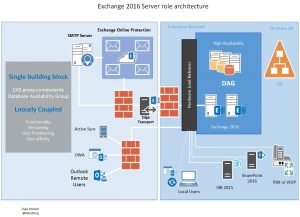
Figure 1.2 Exchange 2016 Server Role Architecture
Other than further consolidation of server roles we would expect a further improved hardware efficiency, much simplified, easier patching, upgrading and deployment process.
There are improvements both at the DAG and CAS level. When creating a DAG, “DatabaseAvailability GroupIPAddress” is no longer required. By default, the failover cluster will be created without an administrative access point, as this is the recommended best practice.
We saw faster database failover time Exchange 2013 SP1 but this to be further improved by another 33% in future cumulative updates and service packs of Exchange 2016.
The removal of CAS role has not affected the simplified name space deployment and layer 4 hardware load balancer will remain a preferred and cost effective choice when it comes to load balancing CAS traffic. Exchange 2016 now also allows you to proxy traffic from 2013 to 2016. This will ease migration process and also eliminates the need of deploying additional front-end infrastructure capacity to serve new Exchange 2016 servers.
Communication between servers occurs at the protocol layer, for example EWS will only talk to EWS with its partner server. Client access service do not perform any rendering rather it just provides client access protocol for authentication, limited redirection and proxy whereas mailbox server handles all the client activity for the active mailboxes it is hosting.
Other Architecture Improvements
Outlook on the Web (Formerly known as OWA) user interface is updated and optimised for tablets and smart phones enhance end user experience. MAPI over HTTP is now the default protocol for outlook to communicate Exchange 2016 and is enabled by default for new Exchange organisations. Any clients which do not support MAPI over HTTP will fall back to RPC over HTTP (Outlook Anywhere). It is more likely that future versions of Exchange may not include RPC over HHTP.
The improved document collaboration we have seem with Exchange online and SharePoint online will be shipped with Exchange 2016.Exchange 2016, along with SharePoint 2016 (currently in preview) will support modern attachments which means Exchange users will be able link and share to documents stored in OneDrive in an on-premises SharePoint server rather than the attachment themselves.
The hybrid configuration wizard (HCW) included with Exchange 2013 has now become a separate downloadable application and multi-forest hybrid deployment are being simplified with Azure AD Connect. Also there new and updated message policy and compliance features in Exchange 2016 for example DLP supports new condition and actions and incident reporting is improved where incident report now can be sent to multiple distribution lists. Also the very first time support for In-place eDiscovery and In-place Hold has been added for public folders with some limitations, great for compliance if you are relying on public folders and we are hoping that area will see further improvements.
Exchange will see great extensibility changes in future. MAPI/CDO is now longer supported. Although EWS is still supported for any application which relay on this but Microsoft is now investing heavily on REST APIs and the apps for Office extensibility model and this extensibility feature. It is not currently included with RTM version of Exchange 2016 but will be later release of Exchange.


Latest posts by Ejaz Ahmed (see all)
- Minimal Hybrid – New Hybrid Migration Options - 11th February 2017
- Exchange 2013 vs Exchange 2016 RTM - 22nd January 2017
- Exchange Federation Services and Free/Busy - 21st January 2017